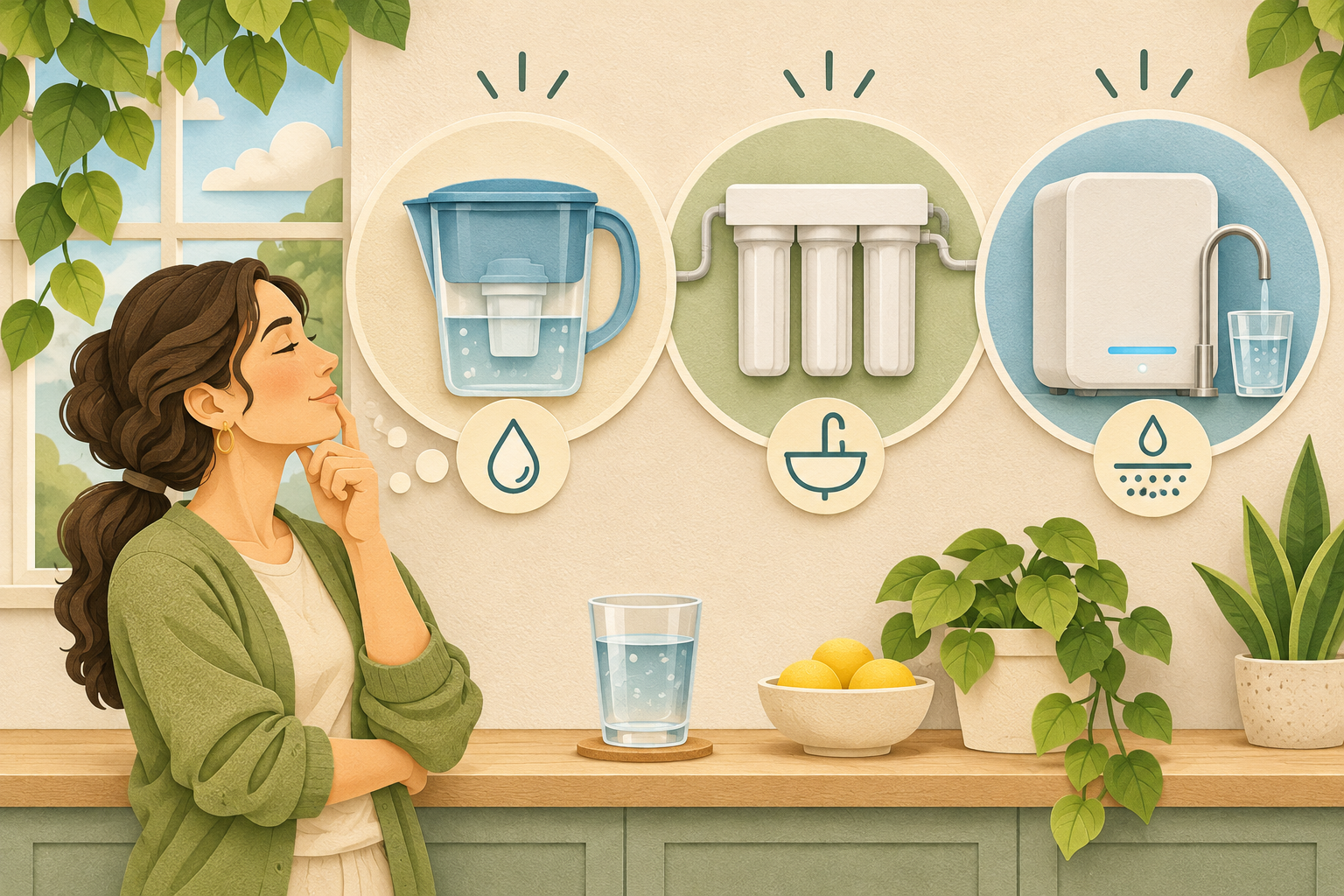
Which Water Filter Do You Need? A Simple Guide
Quick answer: which water filter is best?
The best filter is the one that addresses the problem in your water and has credible evidence that it can do that job. If your public tap water is safe and you only dislike a chlorine taste, an appropriately certified carbon filter may be enough. If you need to reduce certain dissolved contaminants, reverse osmosis might be relevant. If your source is untreated, filtration alone may not make it safe to drink.
I've always liked understanding how equipment works. It's true in the gym, and it turns out it's just as useful when you're looking at water filters. You wouldn't ask a resistance band to do the job of a squat rack. So let's not expect one small cartridge to solve every possible water problem either.
Now that we know why testing matters, how do we choose a filter for the right job? The useful part is matching the treatment to what the water contains, then verifying the result.
Let’s walk the water through the setup. Each stage has a job, and understanding those jobs makes the whole thing less mysterious.
A simple mesh filter can work for overall large debris such as leaves and small rocks.
1. Spin-down filters: take out larger debris
A washable spin-down filter, with an appropriate screen such as 100–150 microns, removes coarse sand, grit and larger particles. Flushing the collected sediment helps protect the filters that follow.
Think of it as taking the muddy boots off before walking through the house. Let this washable first stage deal with the larger mess, rather than asking the finer filters to catch everything.
2. Sediment filters: catch the finer dirt
Once the bigger grit has gone, the 5-micron sediment prefilter catches finer suspended material. That gives the carbon and membranes after it a better chance of working properly.
Five microns is very small, but it still doesn’t mean everything unwanted has been removed.
Very muddy sources may need settling or additional pretreatment first. Fine clay can pass through some cartridges or block them rapidly, and this stage should not be treated as a dependable microbial barrier.
3. Carbon filters: deal with certain chemicals, taste and smell
Activated carbon can reduce chlorine and certain organic chemicals. Its surface and chemistry do the work, while a five-micron rating describes particle capture.
The particular carbon, contact time, flow and remaining capacity determine performance. A claim for pesticides, lead, or PFAS needs evidence for the named substance and exact product.
Untreated spring or rainwater may contain no chlorine to remove, whilst tap water might. Carbon can still have a useful job, but that job should be identified from the source assessment.
4. Charged nanofibre filters: target certain fine particles
By this point, earlier stages may have caught much of the sand, grit and selected substances they were designed to remove. But what about the smaller particles that slip through?
An electrostatically charged nanofibre filter gives those particles two ways to get caught. The fibres are fine enough to catch some as the water passes through. They also carry an electrical charge that attracts particles with the opposite charge. That’s how some filters can hold on to tiny particles and even some microorganisms, or microbes, small enough to fit through the gaps.
So what does 0.2 micron on the label actually tell you? A micron is one-thousandth of a millimetre. But a number on a filter label may describe a nominal or absolute particle rating, depending on the product. It does not, by itself, prove a particular bacteria or virus reduction. Some specifically tested products may reduce certain viruses too. If that’s a job you need yours to do, look for test results showing how well that particular model does it.
The maker of NanoCeram, an electropositive water filtration technology, suggests using its filter before reverse osmosis, the next stage. Catching fine particles here can help protect the delicate layer of material, called a membrane, that does the filtering there. Whether the extra cartridge is worth buying and replacing comes back to what’s in your water.
5. Reverse osmosis: deal with dissolved substances
Think about a pinch of salt stirred into a glass. Once it dissolves, you can’t see the grains any more, but you’d still taste the salt. So how do you take it back out?
Reverse osmosis, usually shortened to RO, uses pressure to push water through a membrane that holds back much of the dissolved material. The water leaves the system in two streams. One gives you treated water. The other carries away what the membrane held back, including much of that salt.
RO can also reduce calcium and magnesium, the minerals that give water its hardness. Some systems can reduce nitrate, nitrite, lead, cadmium, chromium and arsenic. Suitable membranes can also reduce many PFAS (our “forever chemicals”), because many break down very slowly. How much the system removes depends on the substance, the membrane and the conditions it’s working under.
If I were choosing a system, I’d want to know more than “0.001 micron” on the box. I’d look up the exact model and ask, what has this one been tested to remove? You might see NSF/ANSI 58, a standard for drinking-water RO systems. Certification includes a test for reducing total dissolved solids, or TDS. That’s a measure of the overall amount dissolved in the water. If your water test flagged lead, for example, look for lead reduction on that model’s certification. A drop in the overall total can’t tell you how much lead is left.
Sometimes your results will point you towards a different treatment altogether. Ammonia, iron, manganese, certain forms of arsenic, and radioactive substances can each need treatment chosen specifically for them.
And that’s where testing the water first pays off. Once you know what you need to remove, you know what to look for before you spend a penny on the next filter.
Do you actually need all five filters?
Not necessarily. I’ve described these as different jobs, not a shopping list that every home needs.
A mesh or spin-down stage can be helpful if your incoming water contains significant sediment. If you have a regulated public supply and simply want to improve the taste, you might not need any of those coarse pretreatment stages at all.
Look at the named contaminant reduction on the model's certification, the rated flow, the replacement schedule and the cost of maintaining it. NSF/ANSI 42 commonly relates to aesthetic effects such as chlorine taste and smell; NSF/ANSI 53 includes health-related contaminant reduction claims; NSF/ANSI 58 covers reverse osmosis systems. A certification number on its own is not the same as a verified reduction claim for everything on earth.
When a brand tells you its water is 'pure', my next question is simple: pure of what?
Next in the series: How Water Treatment Systems Work. We’ll see how filters, storage and UV can fit together when the source actually requires them.
Your challenge
Before buying a filter, write down the problem you want it to solve: taste, hardness, a named contaminant or something else. Then look for proof the model does that job.
Until next time,
Ash – The Health Coach
Get Health. Heal Trying.
Sources & Further Reading
DWI: Domestic Water Filters and Softeners
https://www.dwi.gov.uk/consumers/learn-more-about-your-water/domestic-water-filters-and-softeners/
NSF: Water Treatment Standards
https://www.nsf.org/consumer-resources/articles/standards-water-treatment-systems
NSF: Reverse Osmosis Systems Standard
https://www.nsf.org/knowledge-library/nsf-ansi-58-reverse-osmosis-drinking-water-treatment-systems


