How Water Treatment Systems Work: RO, UV and Storage
Introduction
I started this whole investigation by asking what I'd do if the shops ran out of water and the taps stopped running. It sounds dramatic, I know. Very COVID toilet-paper situation, except water is a little harder to live without.
That question eventually brought me to filters, tanks, membranes and UV lamps. And one thing became obvious: you can buy a lot of equipment without necessarily having a safe water supply.
So, rather than buying a collection of impressive-looking cylinders and calling it a day, let's look at the job of a complete treatment system.
Quick answer: how does a home water treatment system work?
A system takes incoming water, addresses the specific physical, chemical and microbial hazards found through assessment and testing, and delivers treated water at the point where people use it. Some systems use sediment and carbon filters; others need reverse osmosis, disinfection, storage or treatment for particular substances. There is no universal five-stage system that suits every source.
Why disinfection matters
Say I’ve collected spring water, filtered it and put it in a clean tank. Before I pour myself a glass, there’s one more question worth asking. What if germs got into the water while it was sitting there?
That’s where ultraviolet light, or UV, can help. As water flows past a UV lamp, the light can stop harmful microbes from multiplying. For that to work, the water needs to be clear enough for the light to reach them and flow slowly enough for them to get the right dose. A monitored system checks how well it’s working and automatically shuts off the water if it can’t deliver the dose it’s designed to provide.
That also explains why UV comes near the tap end of the system. If your design includes storage or remineralisation, those stages may need to sit before a final UV treatment point, depending on how the system has been engineered and validated. That way, any germs picked up along the way still have to pass the lamp. Once the water leaves the lamp, the light can’t protect it any further, so the pipes leading to your tap need to stay clean too.
How does the full system fit together?
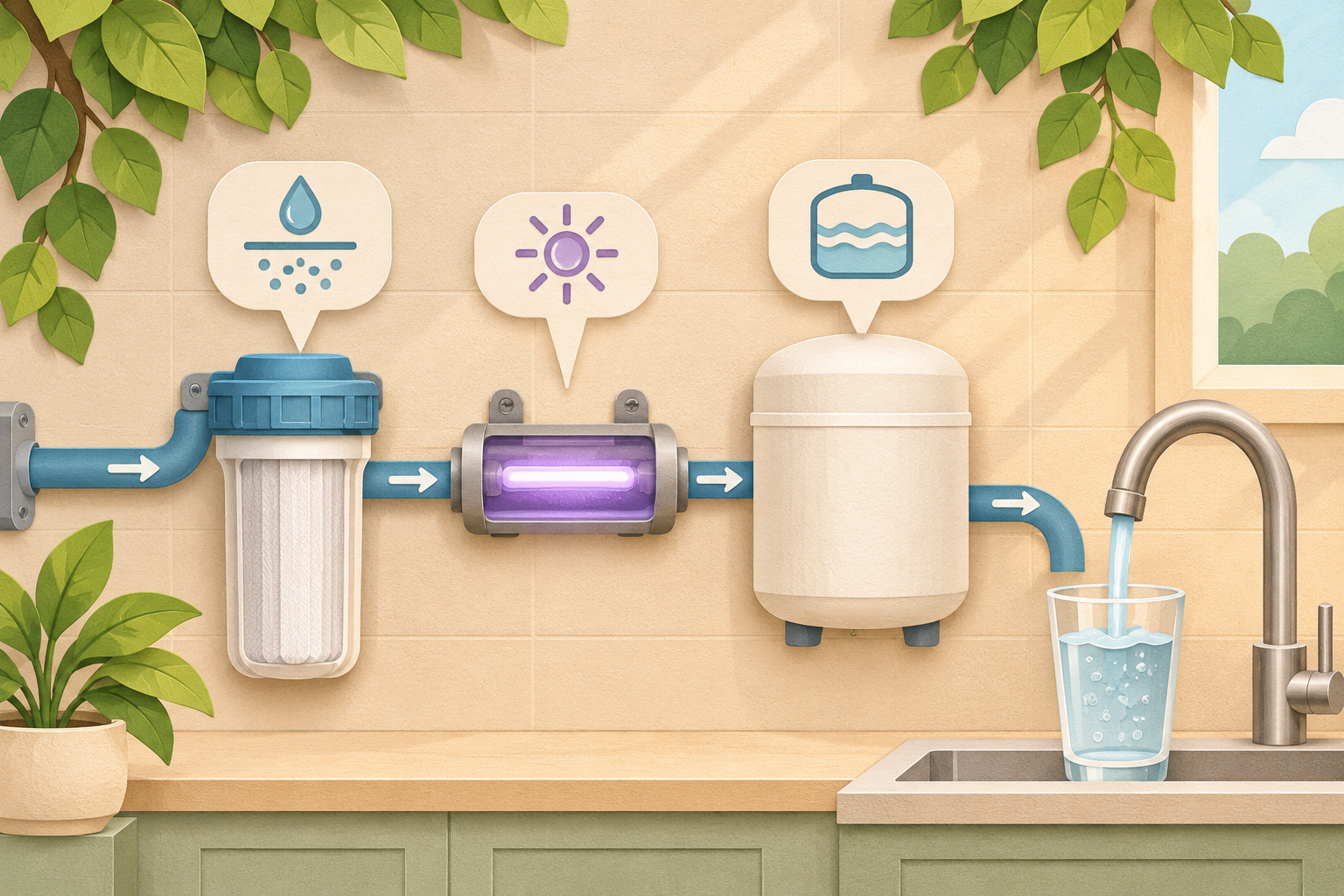
For a source that really does need several treatment stages, I’d think about the journey from collection to the kitchen like this. This is an illustration, not a validated design for a particular water source.
Start at the source. Protect the place where you collect the water. Let the spin-down filter catch the grit, then give the water any extra treatment your source tests show it needs at this point.
Work through the filters. The sediment filter catches finer dirt. Carbon comes next, followed by a charged nanofibre filter if those extra-fine particles are a concern. Then reverse osmosis, or RO, reduces the dissolved substances you’ve chosen it to tackle.
Look after the treated water. Store it in a clean, protected tank if you need one, adjust the mineral balance if needed, then pass it through the final monitored UV system on its way to the tap.
Some sources will need fewer steps. Others may need a different treatment, and sometimes the test results will tell you that a source is simply too difficult or expensive to use. The other part of the decision is how much water you need and how quickly you need it.
Think about a morning when someone’s in the shower, and you turn on the kitchen tap to fill the kettle. Your system has to cope with both at once. That busiest moment is what peak flow means. If your RO system makes treated water more slowly than the household uses it, a tank can store water made earlier, and a pump can deliver it when everyone needs it. For a whole-home setup, that’s where it pays to have a professional size the equipment. The filters and UV still need to do their jobs on a busy morning. If this is just for your drinking water and you're happy with your bathing water, you already have enough information to cover your needs.
If a stage you rely on for safe drinking water fails, switch to a supply you know is safe. Use that for drinking until the fault has been fixed and the checks confirm the water reaching your tap is safe again.
What is the difference between a drinking-water system and a whole-home system?
Think of a morning when someone is in the shower and you turn on the kitchen tap to fill the kettle. If you want to treat every tap in the house, the equipment needs to cope with the busiest simultaneous demand. That's peak flow.
If your aim is only to improve the water you drink and cook with, a suitable point-of-use system at the kitchen tap may be a more sensible and affordable choice.
Reverse osmosis can also produce treated water more slowly than you use it. Some designs include storage and a pump to supply water when you need it. But storage brings its own responsibilities: a dirty tank is a good way to undo the work of a good filter.
For a complex or private supply, have a competent professional specify, install and verify the treatment. And if a disinfection barrier fails, switch to a supply already known to be safe until the problem is fixed and the water has been checked.
Is UV enough to make water safe?
Not on its own in every situation. UV works against certain microorganisms when the equipment is correctly sized, maintained and supplied with sufficiently clear water. It does not remove lead, pesticides, salts or other dissolved chemicals. That is why understanding the starting water matters so much.
I like the idea of being more independent with something as important as water. But I like the idea of being safe even more.
Next in the series: Do You Need Minerals in Your Water? After treatment, should you put anything back?
Your challenge
Decide whether you actually need water treated at one tap or throughout the house. That one question can prevent a lot of unnecessary equipment and expense.
Until next time,
Ash – The Health Coach
Get Health. Heal Trying.
Sources & Further Reading
CDC: About Home Water Treatment Systems
https://www.cdc.gov/drinking-water/about/about-home-water-treatment-systems.html
DWI: Water Testing
https://www.dwi.gov.uk/water-testing/
NSF: Reverse Osmosis Systems
https://www.nsf.org/knowledge-library/nsf-ansi-58-reverse-osmosis-drinking-water-treatment-systems


