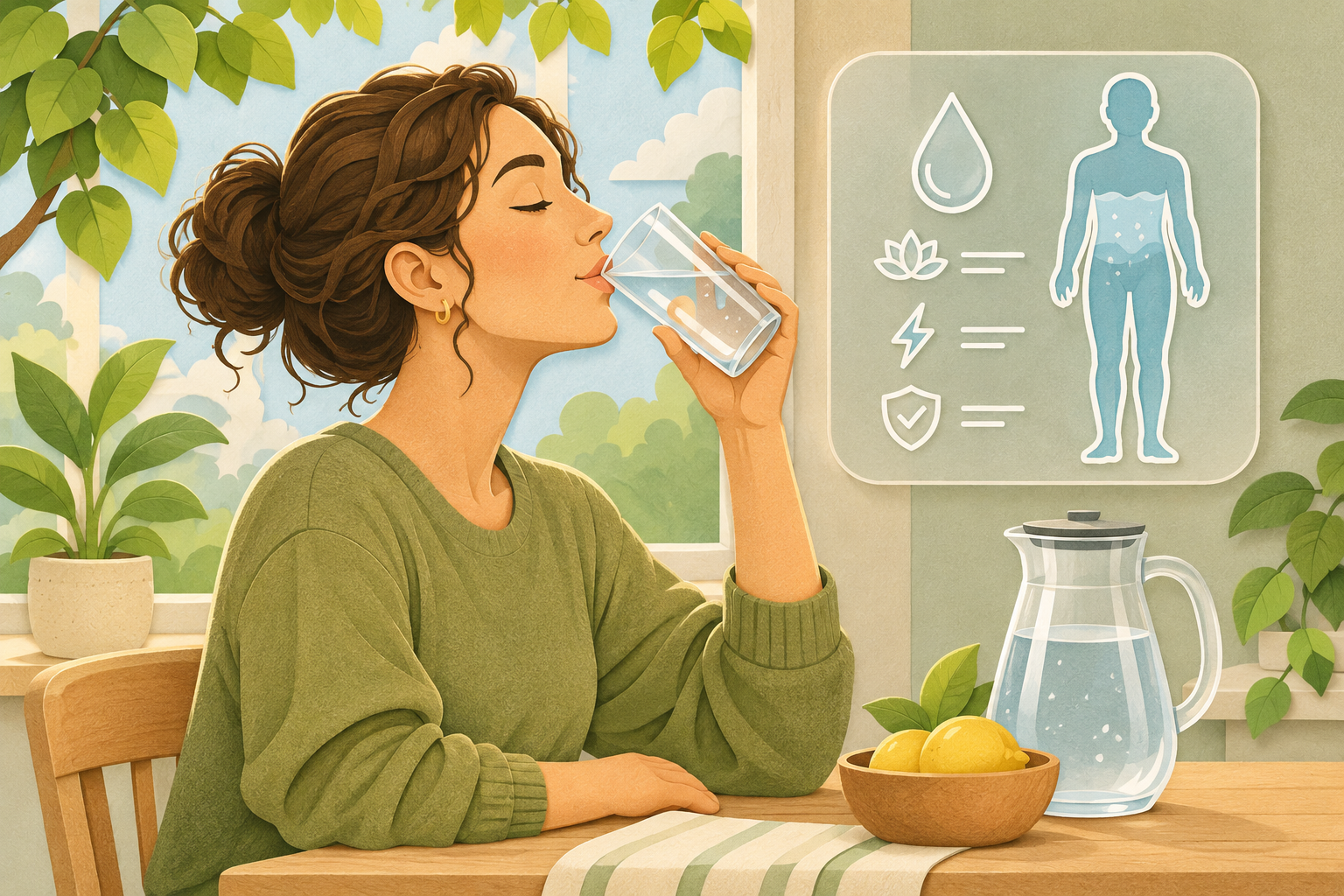
What Happens When You Drink Water? Hydration Explained
Quick answer: what does water actually do for your body?
So now you know how to move better for your health. But what about eating better? Where do you start with that? For me, it took years of studying, trying things, getting things wrong, and learning what actually helped, and then how to stick with it. But before we get into what's on your plate, let’s start with what's in your glass.
Growing up, there wasn’t much of a push to drink water in our house. It usually made an appearance after a long afternoon playing outside, when I told my parents I was thirsty, or when the juice had finished. Which, to be fair, happened quite often.
One thing I will give my parents credit for is that for as long as I can remember, our drinking water was filtered. At the time, I didn’t think much of it. Later, it became one of the reasons I started paying attention to what was actually in my glass.
Now, juice in our house had the lifespan of a biscuit next to a cup of tea. Especially with my sister, who would on occasion drink squash undiluted! What was bought on Saturday was gone by Sunday night. It got to the point where we had family discussions about taking our time with it. You know, some families discuss politics over dinner, we were investigating the disappearance of the apple juice. Now, I’d like to blame the sweet tooth I inherited from my father, but we all had a part to play: water simply wasn’t our first choice. And yet, after a long day running around in the summer sun, nothing tasted better than an ice-cold cup of water. Funny how the drink we kept overlooking was the one we wanted most when we were properly thirsty.
Fast-forward to my mid-20s, and I started asking more questions. What did our filter actually remove? Why was chlorine added to tap water? Where did the water come from before it reached the kitchen? I learned that whilst chlorine can help control harmful microorganisms, its amount needs to be carefully controlled, as too much can be harmful. Then I started learning about the natural water cycle, how water moves through the environment, and the different places we collect it from.
My original question was:
What would I do if I couldn’t buy water and if the taps stopped running overnight?
Call it the COVID-19 toilet-paper situation, but with something harder to live without.
That curiosity eventually took me to Wimbledon to source a bottle of spring water and to the hills of Canonteign Falls where I'd watch part of the water cycle in full effect. It also took me into a much bigger subject: where our water comes from, what it can pick up along the way, and how we work out whether it’s suitable to drink, or not.
So that’s where we’re going.
We’ll look at the places water can be found, the treatments different sources may need, and what actually makes drinking water good quality. Then we’ll explore what you can add to it to make it more enjoyable, and where other ingredients might serve a useful purpose.
Quick answer: what does water actually do for your body?
Water helps regulate your temperature, transport nutrients, remove waste, support digestion and keep your cells and tissues working. The NHS recommends using six to eight cups or glasses of fluid per day as a general guide, adjusting for your activity, the weather and your circumstances. It’s a starting point, not a competition to see who can carry the biggest bottle.
I’d rather you understand why you drink than follow another rule without knowing where it came from.
What is water, exactly?
I remember back to when I first saw a water molecule. This was in secondary school. Two hydrogen atoms joined to one oxygen atom. You’ve probably seen H₂O enough times to recognise it without thinking.
Its shape and the way it shares electrons give the oxygen side a slight negative charge and the hydrogen sides a slight positive charge. The molecule is electrically neutral overall, even though the charge is distributed unevenly. Now these charges make it polar, this means that on different parts of the water molecule it has a different charge. This helps water surround and dissolve many substances.
These attractions also help explain properties such as water’s ability to absorb heat without its temperature shooting up immediately. Useful when you’re trying to get through a workout without becoming a human kettle.
What else is in the glass?
The water we usually drink contains more than just H₂O.
Depending on its source and treatment, it contains dissolved gases, minerals and other substances. These influence its taste and chemistry.
Calcium, magnesium, sodium and potassium are positively charged.
Chloride, sulphate and bicarbonate are negatively charged.
When certain minerals dissolve, they form charged particles called ions. Because ions can carry electrical current through the liquid, these dissolved substances are called electrolytes. You’ll hear that word a lot when people talk about sweating, exercise and hydration.
Can you get water that is very close to pure H₂O? Yes. Distillation evaporates water and collects the condensed vapour, leaving many dissolved substances behind. It is a purification method, although no single treatment removes every possible impurity under every condition.
You might be asking at this point. What about drinking water, how do we know if it’s safe to drink or not? For now, think about these questions:
What’s inside it, and how much of this is present?
Is what's inside it suitable for you to drink?
What happens when you drink water?
Water typically makes up around 50–60% of an adult’s body weight, although this varies with factors such as age and body composition. So how do we replenish it?
You put your phone down
Reach for your glass
Take a few sips
Do that enough times in a day, and you'll have a few litres behind you. That might be a two-second break between emails, but inside your body, there’s a lot more going on.
The water travels down your throat into your stomach, then through your intestines, where most absorption takes place. From there, it enters your circulation and mixes with the water already inside you. Then your body shares that water around.
Some becomes part of blood plasma, the liquid carrying your blood cells and other substances.
Some joins the fluid surrounding your cells, called interstitial fluid.
Together, these fluids are called extracellular fluid, the fluid outside of your cells.
Water is also inside your cells. That is called intracellular fluid, and it accounts for roughly two-thirds of total body water.
I know, there are a few names to take in. But the idea is straightforward: the water you absorb becomes part of your body’s changing fluid balance, moving between your blood, the spaces around your cells and the cells themselves. It doesn’t arrive with a little label telling it where to go.
Now, how does your body decide how much water to keep?
Your kidneys help keep the balance. They regulate how much water you hold and which substances you hold on to, then what leaves in your urine. Urine contains water, creatinine and varying amounts of electrolytes. So if you drink a glass and later need the toilet, that doesn’t mean the drink was wasted. Your kidneys are helping regulate your fluid and electrolyte balance.
To summarise:
Absorption is water moving from the digestive tract into the body.
Fluid balance is how the body manages water coming in, moving around and leaving.
Hydration is your overall state of having enough fluid for normal body function, not simply a count of water inside your cells.
Water helps transport nutrients and waste, supports digestion, hormones and our cells working properly, lubricates our tissues and helps regulate temperature. Quite a lot for something we sometimes remember at four in the afternoon.
For everyday drinking, the NHS suggests six to eight cups/glasses, with more needed depending on your circumstances, such as heat and prolonged activity. Other drinks, including tea and coffee, also count, whilst some foods are more hydrating than others, for example, soups compared to a fried egg. Remember, individual requirements vary.
And if you’ve been wondering whether the source of the water makes a difference, that’s where we’re going next.
Next in the series: Where Does Drinking Water Come From? We'll take this glass on a little journey through clouds, rivers, trees and rocks.
Your challenge
Have a glass with your next meal, then notice when you naturally get thirsty during the day. This isn't about forcing litres down. It's about understanding your body a little better.
Until next time,
Ash – The Health Coach
Get Health. Heal Trying.
Sources & Further Reading
NHS: Water, drinks and hydration
https://www.nhs.uk/Live-well/eat-well/food-guidelines-and-food-labels/water-drinks-nutrition/
USGS: The Water in You
https://www.usgs.gov/water-science-school/science/water-you-water-and-human-body


