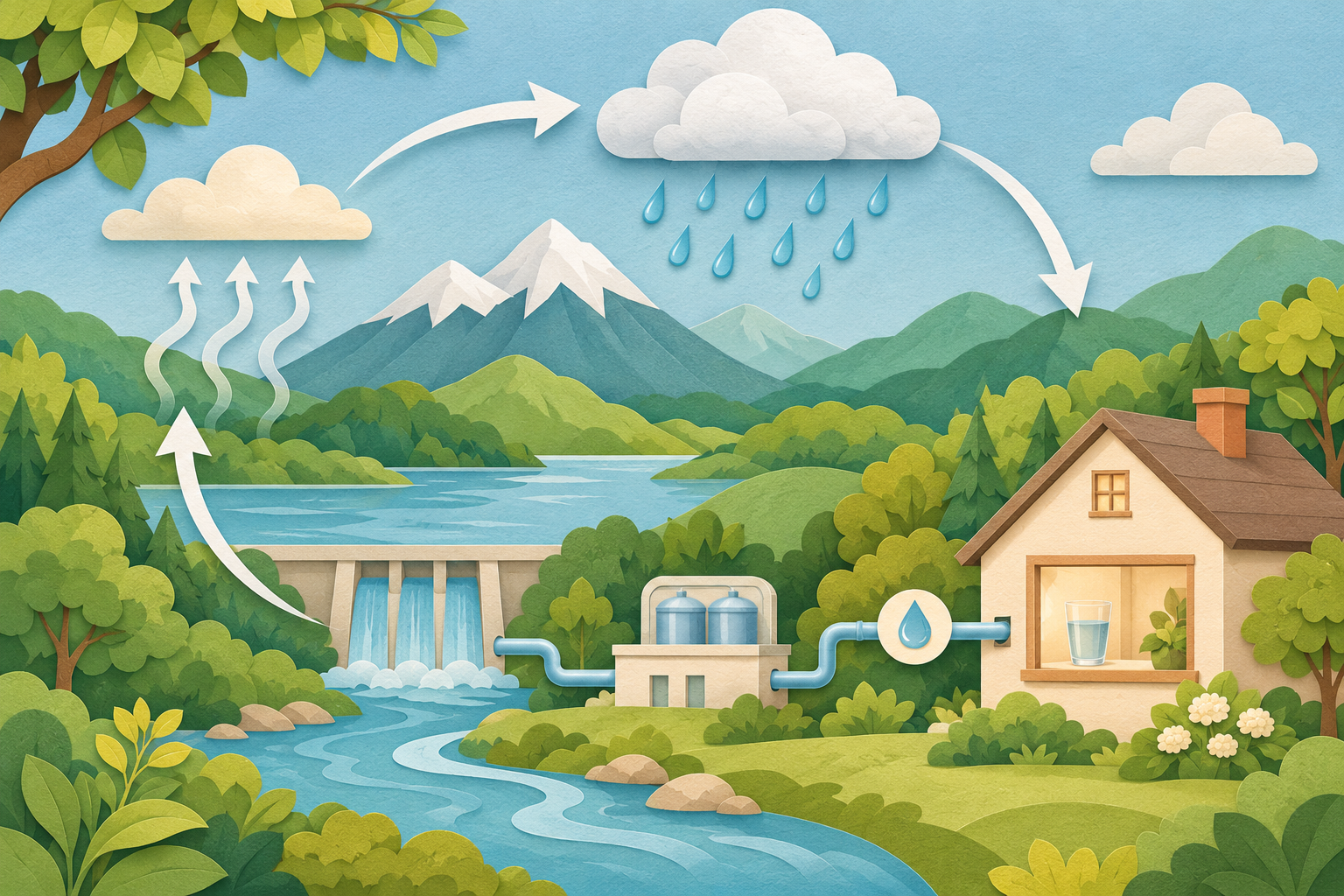
Where Does Drinking Water Come From? The Water Cycle
Quick answer: where does our drinking water come from?
Our drinking water ultimately comes from the water cycle. Rain and snow feed rivers, reservoirs and underground aquifers. In the UK, water suppliers collect water from suitable sources, treat it, check it and send it through pipes to our homes. The source is important, but so is everything that happens between the source and your glass.
The water journey
Now, you might picture spring water coming from a beautiful hillside and tap water coming from somewhere considerably less photogenic. But follow them back far enough, and they have the same origin.
The sun helps water evaporate from the sea, lakes, rivers and land, and the plants release water vapour too.
Trees draw water from the soil through their roots. Some water travels up through the trunk and reaches the leaves, where it can return to the air as vapour. We call that transpiration. Some trees, including birch and maple, can also provide sap, although that is not the same thing as clean drinking water: sap contains sugars and other dissolved substances, and collecting it safely takes care.
Water vapour from plants, oceans, rivers and lakes can cool and condense into tiny droplets or ice crystals, forming clouds before returning as rain, snow or other precipitation.
Rainwater gives us a way to collect water before it travels through a river or aquifer. But air pollution, roofs, gutters and storage can affect it.
The cloud may be doing its part. The bird sitting on your gutter has other priorities.
That’s why we pay attention to how we collect it.
Clouds can also form snow, which can create ice or even glaciers in colder environments.
In any case, protecting the collection system reduces contamination, and testing helps us decide what treatment comes next. A water butt may be brilliant for the garden, but turning it into a drinking-water supply takes a little more thought.
Next, this rainwater runs over the ground.
Some soaks in and contributes to groundwater, while some may be stored as snow or ice in colder places.
Groundwater forms through spaces and cracks in soil and rock. An aquifer stores and moves it; a borehole is a drilled opening used to access it. A spring is where that groundwater emerges naturally at the surface.
As water moves underground, some particles are filtered out, and some minerals dissolve into it, such as calcium from rock.
A well-protected spring can be a useful source, but we need to know the surroundings.
The spring water combined with the runoff from the rainwater can continue flowing to form streams, rivers and lakes.
This is surface water, which is more exposed to what happens around it. Rain can wash soil, agricultural chemicals and waste into a river and change its quality.
Now I understand the appeal. You’re outside, the water’s flowing, and it looks very inviting. But that picturesque appearance doesn't tell you what you might swallow. A suitable, properly verified treatment method may help, but a basic camping filter does not automatically make river water safe to drink.
Surface water is an important source for public drinking-water supplies. Water companies treat and monitor it before it reaches our taps. Collecting and treating untreated river water yourself is a different job, and one that requires more than hoping the water looks clean.
From here, rivers and deep groundwater can flow into the sea; seawater needs desalination using equipment designed for its high salt content.
Then there is ocean water, which, once evaporated, continues the water cycle!
From the sources mentioned, there are different ways of making water suitable for drinking. The important part isn’t whether it came from nature or passed through machinery; it’s what the water contains and whether the treatment addresses those risks. A beautiful spring can be contaminated. A treated tap supply can be perfectly suitable to drink. Nature and man-made systems each need to be understood rather than assumed to be better.
Even if you never plan to collect your own water, understanding its journey makes you better equipped to ask sensible questions about tap water, bottled water and filters.
Why the journey matters
I ended up travelling to Wimbledon to source a bottle of spring water and out to Canonteign Falls to watch part of this cycle in action. You can read about evaporation in a book, but standing near flowing water makes you look at it differently. Where did it come from? What did it pass through? What would I need to know before drinking it?
The same questions apply to rainwater, spring water and water from the kitchen tap. Looking natural is not a safety certificate, and being treated isn't automatically a bad thing.
Next in the series: Is UK Tap Water Safe to Drink? We're going into what happens once water is collected for our homes.
Your challenge
Next time it rains, think about where that water could travel before it becomes somebody's drinking supply. It makes your usual glass feel a little less ordinary.
Until next time,
Ash – The Health Coach
Get Health. Heal Trying.
Sources & Further Reading
USGS: Water Cycle
https://www.usgs.gov/water-science-school/water-cycle
USGS: Groundwater Flow and the Water Cycle
https://www.usgs.gov/index.php/special-topics/water-science-school/science/groundwater-flow-and-water-cycle


