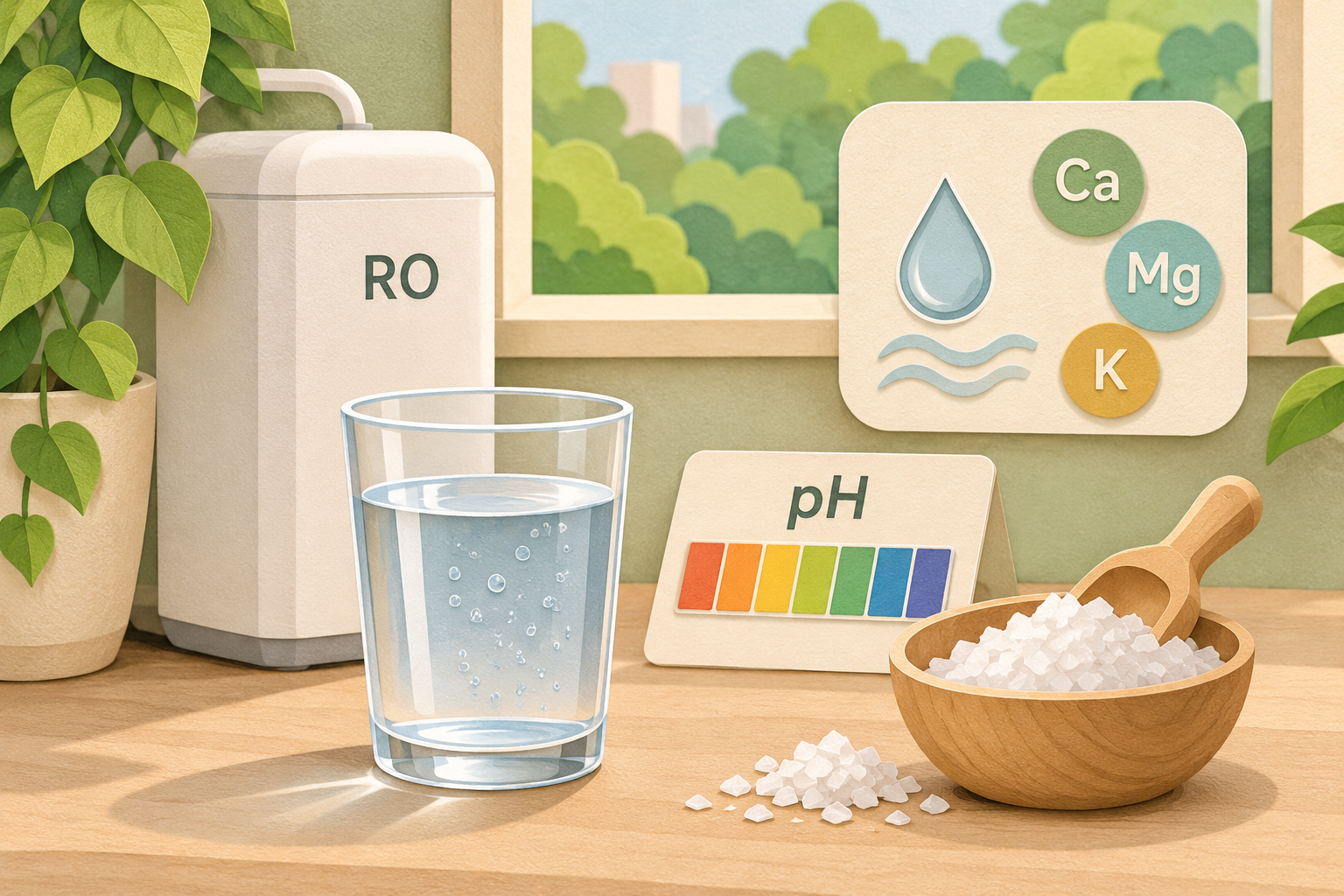
Do You Need Minerals in Water? pH, RO and Sea Salt
Introduction
I remember the first time I properly looked at a mineral-water label rather than just checking whether the bottle was cold. Calcium, magnesium, sodium, bicarbonate. Suddenly I had another set of questions.
What are these minerals doing in the water? Are they useful? And if a reverse osmosis filter takes them out, should we put them back in?
I have the same habit when I'm looking at somebody's nutrition. Before adding another supplement or making a big change, I want to know what is missing and whether changing it would actually be useful.
Quick answer: do you need minerals in drinking water?
Water can contribute minerals such as calcium and magnesium to your intake, but most people also get these through food. You do not need to add minerals to every glass to make your body 'absorb' water. After reverse osmosis, remineralisation can sometimes help with taste, water chemistry and stability. The right choice depends on the water and the system.
Imagine you’ve checked your source, chosen suitable treatment and verified the water is safe to drink. Remember when I mentioned that you might want to remineralise water after RO? Let's see how we can do this and more! Then I can finally get to the part I was looking forward to as a child: actually enjoying the drink.
We’ve looked at where it comes from, what might be in it and how to make it suitable to drink. Once that’s established, we can work on its mineral balance, look after it properly and make it something you reach for without having to remind yourself.
How does mineral balance affect water?
Remember the minerals water picks up as it travels through rock? Some of them, like calcium, can contribute to what you get from food. If you buy bottled water and you’re curious how much your water adds, look at the number next to the mineral on the label.
Say it lists 100 mg of calcium per litre. Drink a 500 ml bottle, and you’ve had half a litre, so that’s 50 mg of calcium. That’s how much you’ve swallowed. How much your body absorbs is a different question.
So why would we put minerals back after reverse osmosis (RO) has taken them out? One reason is that the treated water can lose some of its ability to resist changes in pH. Two readings help explain what that means.
pH tells you how acidic or alkaline the water is.
Alkalinity tells you how well the water can resist a drop in pH when acid is added. That ability is called buffering.
Two glasses of water can start at the same pH. Add the same small amount of acid to each, and the one with less buffering capacity can see a bigger drop. That’s why we check both readings, along with hardness, which mainly comes from calcium and magnesium. There’s no prize for the highest pH. The aim is water that stays stable and suits the pipes it travels through.
If testing shows the water has a low pH and little buffering, one option is to pass it through calcite, a form of calcium carbonate. As a little calcite dissolves, it adds calcium back, helps raise the pH and restores some of that buffering. That’s what remineralisation means here.
And what about a pinch of sea salt? That mainly adds sodium and chloride. If your water needs calcium or more buffering, sea salt won’t do that job. It also isn’t automatically going to improve hydration during an ordinary day. Sodium replacement can matter after prolonged, heavy sweating, but that’s a different situation from putting salt in every glass at your desk.
Is alkaline water better for hydration?
You'll often see a big pH number presented as though it were a trophy. But higher isn't automatically better.
The body regulates its blood pH tightly. Drinking higher-pH water does not mean you've meaningfully alkalised your blood, nor does it establish that you will hydrate better. The practical water-treatment reason to think about pH and alkalinity is whether the water is stable and compatible with the equipment and plumbing it travels through.
I’d rather see a water-quality report than a marketing label that looks like the water has just graduated from university.
How much calcium are you really getting from water?
Look at the label and do a quick bit of maths. If there are 100 mg of calcium in each litre, a 500 ml bottle provides 50 mg. That tells you the amount you've swallowed, not automatically how much your body will absorb or whether you need more calcium in the first place.
For somebody training regularly, I would look at the bigger picture: meals, drinks, sweat loss, medical circumstances and what is practical enough to keep doing.
Should you add sea salt to water?
For a normal working day, you usually don't need to. If you are doing a long, hot, very sweaty session, replacing fluid and sodium may be useful; the amounts depend on what you lose and how long you're active. That can be through food, suitable drinks or a properly formulated rehydration product, not guesswork with a salt grinder.
Next in the series: How to Drink More Water. Once you've decided what goes into the glass, let's make drinking it easier.
Your challenge
Look at the label on your next bottle of water. Check the calcium, magnesium and sodium values, and ask what they contribute instead of judging the bottle by its branding.
Until next time,
Ash – The Health Coach
Get Health. Heal Trying.
Sources & Further Reading
NHS: Water, Drinks and Hydration
https://www.nhs.uk/Live-well/eat-well/food-guidelines-and-food-labels/water-drinks-nutrition/
DWI: Domestic Water Filters and Softeners
https://www.dwi.gov.uk/consumers/learn-more-about-your-water/domestic-water-filters-and-softeners/
NSF: Reverse Osmosis Standard
https://www.nsf.org/knowledge-library/nsf-ansi-58-reverse-osmosis-drinking-water-treatment-systems


